Since establishing this idea, I have thought of a number of examples that apply and hope to outline a few to continue this dialectic. I think in one sense, there is a link between individualism and American ideology that is actually fairly common, but I don't think that is the full extent of the historical basis (particularly because the United States is relatively young when it comes to art history, and certainly not the first to use the idea of art as expression). I think this is more historically entrenched in the history of visual art (and other disciplines, perhaps) and will be harder to question and more difficult for people to accept, but these ideas are worthwhile.
I should also restate some of the texts that I have been reading that is certainly contributing to this thinking, primarily Dylan Trigg's book The Thing, Ben Davis's 9.5 Theses on Art and Class, and Eugene Thacker's In the Dust of this Planet.
So...
The ongoing assumption has been that art is a matter of individual expression, and has been critiqued, theorized, looked at, and thought about as such. At the very least this is a gross over simplification, if not a terrible mistake, because it does not acknowledge the complexity of an individual identity. I must be careful of my verbiage here, because a lot of these words have philosophical baggage (identity, for one) but what I am referring to is the individual that produces/creates art. I think this can also be the same for a group of artists functioning as a unit to produce a single art work (such as the Guerrilla Girls) that can be assessed. What does not fall under this delineation is a group like Bruce High Quality Foundation that organizes classes, exhibitions, etc, which gets into the downward slope of "social practice as art", and I don't want to go into that here. Mainly, I'm talking about an individual artist working on their artistic product.
Looking at artworks as individual expression assumes that one can know the individual and know, by looking at a body of their work, what they are expressing. The inherent fault in this is that an individual may have some similar traits from one creation to the next, other traits of the individual have changed. The individual is not a collection of their work, nor is individual a constant during production of a single work. Individuality manifests itself in a number of ways and includes moments of disconnect (not fully understanding one's actions, being at odds with ones self) as well as moments where one individual overlaps and mirrors another individual. These manifestations of individuality are so complex that it is questionable whether one can effectively evaluate "individual expression" as the motive and origin of the art work.
In watching Chris Marker's film La Jetee, the character of 'the man' is the subject of an experiment made necessary by the nuclear destruction of Paris (and, presumably, most of the rest of the world) after World War III. The men organizing the experiment inject the man with drugs that aid him in to travel back in time, and along with electrodes that cover his eyes, he is able to place himself as an individual as an adult in a time before the war, where he eventually interacts with a woman that he remembers from a day on the pier. The organizers of the experiment also learn how to send him in to the future, where he meets humans and is made aware that the race survives. The man knows that his time is limited and is no longer useful to the experiment or its organizers, and chooses to return to the past to meet the woman on a pier.
One analogy that Marker's film provides is an evaluation of the individual in a way that is not often thought about, even though we know and accept (since Einstein) that time is relative. Certainly the film is speculative fiction in form and genre, but I see La Jetee as a parallel to the complexity of individuality; the concept of the individual should not be restricted by time, nor determined by time. I am completely able to return to thoughts, moods, and mind-frame of different times in a way that makes my own individuality parallel to itself as opposed to linear recurrences. If I get angry every time I'm driving a car, it is not time that determines my anger but the context of driving. Other individuals also get angry while driving a car, and all of these occurrences of anger in driving are called road rage--not linked to time (other than, one could argue, since the invention of the automobile) but linked to the context of the individual.
Both of these words, too, are problematic in a phenomenological sense; if one doesn't take into account the complexity of the individual, phenomenology can be relegated to the realm of outdated and modernistic (if phenomenology is only the philosophy of an individual in a restricted sense it can not necessarily account of a multiplicity of realities, or at least there is some contradiction in this). Expression, too, then is an issue in terms of its origins in the individual, a sort of paradox (an individual studying and thinking about something created by the individual, which probably can't be fully evaluated).
***
Showing posts with label phenomenology. Show all posts
Showing posts with label phenomenology. Show all posts
Saturday, April 25, 2015

Wednesday, March 6, 2013
storytelling: said three times
One idea that has resurfaced in my studies and studio work is a bit harder for me to define; attempting to explicate it might flush out the ideas a bit more. In the very least, I'll be able to portray the notion with some examples and help outline the area in which I speak:
I originally started reading sources about spirituality and mysticism after finding (rather mysteriously, I might add) the book Pow Wow or Long Lost Friends in my basement, among other books. The book is a hexmeister's guide (a healer from the Pennsylvania Dutch community)--one of the few published that I know of. To see all of the cures, suggestions, superstitions, and instructions on dealing with every day issues is quite astounding. Somewhere and somewhen close to the time of that discovery, I also read a quote from a book that more or less explained the reason for things said in threes as that whatever is stated three times becomes real. Obviously, this reality is ambiguous, and multi-faceted, but I'm not going to put that "real" in quotes above because that is the heart of my interest and what I'm trying to describe as an integral part of my research.
I have just come to it again, in a reading for a class, by the author Trin Minh-Ha, in her essay 'Grandma's Story.' Part of the implications in this essay are that the telling of the story brings life, and, inversely, our collective living is necessary for the telling of the story. The ontological part of this is profound and simple; the way we think about something being said becoming a reality (or, at least, a history) is interesting.
As plainly as I can speak of it; my interest is in how words--a simple and integral symbol belonging to our structure of communication--can invoke a sort of or sense of reality. Reality, here, is linked to being. Being, too, is linked to our perceptual experience (I was asked the other day by a friend if I still considered myself a phenomenologist; I do, without a doubt, but I think that I am trying to redraw those parameters in my thinking. I think my ideology is a sort of phenomenology that runs parallel to ontology; often overlapping).
I also think of a clip of Errol Morris's Vernon, Florida with a man sitting on a bench and saying something similar to "Reality, is that what you call this?" I think this removes my ideas a bit from their original context in the sense that I am not solely concerned with the nature of reality or its interpretation. Somehow this seems to be an oversimplified way of stating it. I do think it is part of it, though--perhaps what I am thinking about is how symbols interface with our interpretations of reality.
---------
I've got a lot going on outside of the studio this year--it has been nice to see a lot of people and meet new friends through my travels. Here is a list of the exhibitions, including some additional material to follow up on:
House of the Seven Gables at University Galleries, Normal, Illinois
http://finearts.illinoisstate.edu/galleries/
February 23 - April 7, 2013.
Its a great exhibition--please go see it if you are able! Lots of great artists involved.
Interview with Kendra Paitz on StudioBreak, concerning the ideas and the exhibition:
http://StudioBreak.com/highlight-episode-14-the-house-of-the-seven-gables-curator-kendra-paitz/
Rooted/Grounded
Two person exhibition with Diana Gabriel, curated by Angela Bryant.
Design Cloud Art Gallery, Chicago, IL
https://www.facebook.com/events/516429468399939/?fref=ts
Opening reception March 15, 6pm Including a panel discussion with Diana Gabriel and I.
coming up this year:
Solo exhibition, The Soothsayer, at Box13 in Houston,Texas--July 2013
Solo exhibition, Jan Brandt Gallery, Bloomington, Illinois--October 2013
I originally started reading sources about spirituality and mysticism after finding (rather mysteriously, I might add) the book Pow Wow or Long Lost Friends in my basement, among other books. The book is a hexmeister's guide (a healer from the Pennsylvania Dutch community)--one of the few published that I know of. To see all of the cures, suggestions, superstitions, and instructions on dealing with every day issues is quite astounding. Somewhere and somewhen close to the time of that discovery, I also read a quote from a book that more or less explained the reason for things said in threes as that whatever is stated three times becomes real. Obviously, this reality is ambiguous, and multi-faceted, but I'm not going to put that "real" in quotes above because that is the heart of my interest and what I'm trying to describe as an integral part of my research.
I have just come to it again, in a reading for a class, by the author Trin Minh-Ha, in her essay 'Grandma's Story.' Part of the implications in this essay are that the telling of the story brings life, and, inversely, our collective living is necessary for the telling of the story. The ontological part of this is profound and simple; the way we think about something being said becoming a reality (or, at least, a history) is interesting.
As plainly as I can speak of it; my interest is in how words--a simple and integral symbol belonging to our structure of communication--can invoke a sort of or sense of reality. Reality, here, is linked to being. Being, too, is linked to our perceptual experience (I was asked the other day by a friend if I still considered myself a phenomenologist; I do, without a doubt, but I think that I am trying to redraw those parameters in my thinking. I think my ideology is a sort of phenomenology that runs parallel to ontology; often overlapping).
I also think of a clip of Errol Morris's Vernon, Florida with a man sitting on a bench and saying something similar to "Reality, is that what you call this?" I think this removes my ideas a bit from their original context in the sense that I am not solely concerned with the nature of reality or its interpretation. Somehow this seems to be an oversimplified way of stating it. I do think it is part of it, though--perhaps what I am thinking about is how symbols interface with our interpretations of reality.
---------
I've got a lot going on outside of the studio this year--it has been nice to see a lot of people and meet new friends through my travels. Here is a list of the exhibitions, including some additional material to follow up on:
House of the Seven Gables at University Galleries, Normal, Illinois
http://finearts.illinoisstate.edu/galleries/
February 23 - April 7, 2013.
Its a great exhibition--please go see it if you are able! Lots of great artists involved.
Interview with Kendra Paitz on StudioBreak, concerning the ideas and the exhibition:
http://StudioBreak.com/highlight-episode-14-the-house-of-the-seven-gables-curator-kendra-paitz/
Rooted/Grounded
Two person exhibition with Diana Gabriel, curated by Angela Bryant.
Design Cloud Art Gallery, Chicago, IL
https://www.facebook.com/events/516429468399939/?fref=ts
Opening reception March 15, 6pm Including a panel discussion with Diana Gabriel and I.
coming up this year:
Solo exhibition, The Soothsayer, at Box13 in Houston,Texas--July 2013
Solo exhibition, Jan Brandt Gallery, Bloomington, Illinois--October 2013
Tuesday, February 5, 2013
The Sleeping Ghosts
Though I've wanted to keep school out of the content of this blog as much as possible, undoubtedly things are going to sneak in; I've forgotten how much teaching permeates one's ideas and thinking during the semester (that is, until one has to rebel against it for the sake of sanity). Most of these ideas will be cloaked in studio practice but they undoubtedly have origins or links to the classroom.
I've revisited Locke's Memory Theory of personal identity and it has some interesting implications on studio practice. I actually am reading it anew, I think, as I was introduced to it by a philosopher named John Perry. Locke's theory can be written out as the following:
A is the same person as B if and only if A can remember having an experience of B's.
As simple as that sounds, and as most of us would agree with it in the sense that personal identity is difficult to define and claim having without the aid of memory, it still offers complex insight into being an artist and making work over time. We often consider that artists work with the concept of identity; but I'd like to call attention to the fact that it is a crutch of poorly expressed ideas in art. Philosophy has puzzled over how to define the A/B of Locke's theory, and as far as contemporary art is concerned, I would assert that we can take it as a representation of the artist.
Now, I am in no way thinking that this solves the conundrum of personal identity in a philosophical sense, but artists as makers have the benefit of physical remnants of their memories; not in totality, but in the sense that I do not remember making work in undergraduate studies but that artwork still exists and poses my identity in some form. Surely non-artists have physical remnants--an individual purchases a car, for example, and wakes up the next morning remembering that he purchased the car and thereby establishing his identity in a philosophical sense--but as artists most of us have work built up from years of work. I have a room in my basement that is full of this identity establishing objects that have built up over the last 10 years of making things and paintings. All in one place it is quite profound--even to me, alone, with no one else looking.
I remember reading an article by Morton Feldman talking about a studio visit with Philip Guston, and describing the paintings, as they walked out of the room, as sleeping giants. I think I understand what I Feldman was getting at, but when I go into the basement to add more work to the room of past acts I think of them as sleeping ghosts; they exist in my mind, phenomenally, and establish my past and my identity without being on view or exhibited. Stacked, they have a collective power that demands that I continue to feed it with more and more work!
Identity is the totality of the art world; even artists that work to remove evidence of the hand are still exerting their identity into their work. Different artists may use parts of the concept of identity in their work which is different from others, and maybe certain artists emphasize a specific part of identity in a way that they should talk about the work as involving identity, but in truthfulness, identity is the structure for everything that an artist does. Using it is also as nefarious as stating that your work is about nature; but identity should be the given that we all rely on.
I think I may switch paths to more creative writing for the next post...more to come.
Current reading, listening, and watching has involved:
From A to X by John Berger
Dark Holler, Smithsonian Folkways
Jiro Dreams of Sushi
etc...
new studio work also posted on the website. More always on its way.
I've revisited Locke's Memory Theory of personal identity and it has some interesting implications on studio practice. I actually am reading it anew, I think, as I was introduced to it by a philosopher named John Perry. Locke's theory can be written out as the following:
A is the same person as B if and only if A can remember having an experience of B's.
As simple as that sounds, and as most of us would agree with it in the sense that personal identity is difficult to define and claim having without the aid of memory, it still offers complex insight into being an artist and making work over time. We often consider that artists work with the concept of identity; but I'd like to call attention to the fact that it is a crutch of poorly expressed ideas in art. Philosophy has puzzled over how to define the A/B of Locke's theory, and as far as contemporary art is concerned, I would assert that we can take it as a representation of the artist.
Now, I am in no way thinking that this solves the conundrum of personal identity in a philosophical sense, but artists as makers have the benefit of physical remnants of their memories; not in totality, but in the sense that I do not remember making work in undergraduate studies but that artwork still exists and poses my identity in some form. Surely non-artists have physical remnants--an individual purchases a car, for example, and wakes up the next morning remembering that he purchased the car and thereby establishing his identity in a philosophical sense--but as artists most of us have work built up from years of work. I have a room in my basement that is full of this identity establishing objects that have built up over the last 10 years of making things and paintings. All in one place it is quite profound--even to me, alone, with no one else looking.
I remember reading an article by Morton Feldman talking about a studio visit with Philip Guston, and describing the paintings, as they walked out of the room, as sleeping giants. I think I understand what I Feldman was getting at, but when I go into the basement to add more work to the room of past acts I think of them as sleeping ghosts; they exist in my mind, phenomenally, and establish my past and my identity without being on view or exhibited. Stacked, they have a collective power that demands that I continue to feed it with more and more work!
Identity is the totality of the art world; even artists that work to remove evidence of the hand are still exerting their identity into their work. Different artists may use parts of the concept of identity in their work which is different from others, and maybe certain artists emphasize a specific part of identity in a way that they should talk about the work as involving identity, but in truthfulness, identity is the structure for everything that an artist does. Using it is also as nefarious as stating that your work is about nature; but identity should be the given that we all rely on.
I think I may switch paths to more creative writing for the next post...more to come.
Current reading, listening, and watching has involved:
From A to X by John Berger
Dark Holler, Smithsonian Folkways
Jiro Dreams of Sushi
etc...
new studio work also posted on the website. More always on its way.
Monday, January 28, 2013
Thank you, Fog; or the last of things
The sense of one's last works before death is absolutely filled with portent (the inevitability of our own end), poetics, and beauty; though all of us that make things understand that it is not quite as simple as working up to our last work, the last of things is haunting and sad. Auden's last poems (Thank You, Fog), collected and published posthumously, are far from the most interesting things he has written; when I read them, they even verge on being trite and lack his expected bite and observation. There is a phenomenological symbolism to them, though, that transcends the nature of the poetry to take on a new meaning as a collection, as a piece of history published.
The fog is a strong presence outside today, and undoubtedly it reminds me of the symbol of Auden's last works. The fog is not only an element of weather that creates a different sense of space and feeling of being outside (moisture hanging heavy in the air) but it is also an element of ambiguity, an obscurer, the thing that erases edges that are a distance away. Its density is at once tangible and soft, and I actually find it quite comforting, even in the winter months.
Is there a visual reminder connected to fog? To a sort of passage that could be connected to what is after life? Not 'the afterlife', mind you, which is a concept wrought with pre-determined images. I might argue that fog creates a spatial complexity that leads to our typically path-oriented minds to be less sure of the direction in which one should travel, in a metaphoric and metaphysic sense. It is not that we don't know where we are going, but the space that we typically understand as being a part of the journey is less clear than normal.
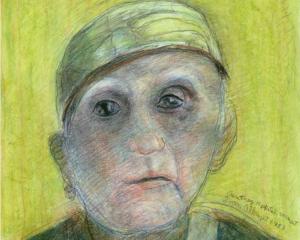
Posthumous works of art and literature support this idea, I believe. One of the most astounding things I've seen at the Art Institute was a series (a progression) of Ivan Albright's self portraits, two of which are below. The last portrait he did before his death (1983) is shocking. Though it may sound obvious, his head takes up less and less space in each composition. The portraits seem fuller of questions at the end, not finality or decisiveness that would point towards an artist at their peak. This is not to assert that artists make their best work at some other time and then slowly fall downhill until death; rather, it is to say, that death is a progression that is unavoidable, but it is not related to making. I would also argue that it is hard for any maker to live up to the pressure of last works and posthumous work; the symbol that they stand for themselves is enough.
I remember being curious about Gilbert Stuart's unfinished portrait of George Washington in my art history texts--wondering why it was important in terms of art history. I think of it as an amazingingly important work to my own understanding of the phenomenological power of an image and a painting; but I don't think that is often the topic of art history books.
Other posthumous works that I have been interested in are Wei Wu Wei's Posthumous Pieces (which was printed in Hong Kong many years before Wei's death, but is still interesting in this context, as it deals with the death of a sense of individuality or identity in some respects) and Roberto Bolano's 2666. There is a wiki list of works published posthumously, found here:
http://en.wikipedia.org/wiki/List_of_works_published_posthumously
Ivan Albright, Self Portrait 1980 Ivan Albright, Self Portrait, 1983

The fog is a strong presence outside today, and undoubtedly it reminds me of the symbol of Auden's last works. The fog is not only an element of weather that creates a different sense of space and feeling of being outside (moisture hanging heavy in the air) but it is also an element of ambiguity, an obscurer, the thing that erases edges that are a distance away. Its density is at once tangible and soft, and I actually find it quite comforting, even in the winter months.
Is there a visual reminder connected to fog? To a sort of passage that could be connected to what is after life? Not 'the afterlife', mind you, which is a concept wrought with pre-determined images. I might argue that fog creates a spatial complexity that leads to our typically path-oriented minds to be less sure of the direction in which one should travel, in a metaphoric and metaphysic sense. It is not that we don't know where we are going, but the space that we typically understand as being a part of the journey is less clear than normal.
Posthumous works of art and literature support this idea, I believe. One of the most astounding things I've seen at the Art Institute was a series (a progression) of Ivan Albright's self portraits, two of which are below. The last portrait he did before his death (1983) is shocking. Though it may sound obvious, his head takes up less and less space in each composition. The portraits seem fuller of questions at the end, not finality or decisiveness that would point towards an artist at their peak. This is not to assert that artists make their best work at some other time and then slowly fall downhill until death; rather, it is to say, that death is a progression that is unavoidable, but it is not related to making. I would also argue that it is hard for any maker to live up to the pressure of last works and posthumous work; the symbol that they stand for themselves is enough.
I remember being curious about Gilbert Stuart's unfinished portrait of George Washington in my art history texts--wondering why it was important in terms of art history. I think of it as an amazingingly important work to my own understanding of the phenomenological power of an image and a painting; but I don't think that is often the topic of art history books.
Other posthumous works that I have been interested in are Wei Wu Wei's Posthumous Pieces (which was printed in Hong Kong many years before Wei's death, but is still interesting in this context, as it deals with the death of a sense of individuality or identity in some respects) and Roberto Bolano's 2666. There is a wiki list of works published posthumously, found here:
http://en.wikipedia.org/wiki/List_of_works_published_posthumously
Ivan Albright, Self Portrait 1980 Ivan Albright, Self Portrait, 1983
 |
| Gilbert Stuart, 1796 |
 |
| January 28, 2013 Des Moines, Iowa |
Subscribe to:
Posts (Atom)