Showing posts with label ontology. Show all posts
Showing posts with label ontology. Show all posts
Wednesday, March 27, 2013
painting, meaning, and dogma
I re-watched and considered a documentary called Examined Life the other day and, as I was in the studio, I contemplated something that Avital Ronell considers in her segment of the film. In walking, Ronell talks about our desperate search for meaning and the resulting gravitation towards ideologies as a quick fix to the absence of meaning; which also provides a fast frame of reference for how one should act. Near the end of her interview she even equates junk food and junk thinking, insinuating that to rely on these quick fixes when it comes to finding meaning is similar to eating a candy bar for dinner--it provides calories, but very little nutritional value in those calories. I'm asserting my interpretation a bit here, but it lead me to consider (or re-consider, as I feel like I come to this in my studio practice fairly regularly) the idea of meaning in painting, especially in terms of a "search" for meaning.
I think this search for meaning is an integral part of painting (and, ideally, art making in general: though I am a novice photographer I feel that taking photographs can serve the same function as painting does in this regard) as it provides me with a medium to eradicate ideology and dogma. One could argue, I suppose, that abstraction is its own dogma; but in my own studio abstraction is the path that I often choose (though I do make things, objects, take photographs, etc) without any real reason; none of my paintings necessitate abstraction nor do I have to make abstract paintings (which would signify dogma, I think) in order to use paint.
I've tried a number of times to watch Gerhard Richter Painting and I have to say that it has not happened, for various reasons. I think there is part of the celebrity of Richter that bums me out a bit. I have also read parts of The Daily Practice of Painting by Richter, so I thought I would consult the book in terms of these thoughts to see what Richter, who a lot of painters idolize, would have to say. I have a tremendous amount of respect for Richter, but he has not been someone that I have readily connected with I found these, at first opening of the book:
"23 July 1989. However ineptly--desperately ineptly--I set about it, my will, my endeavor, my effort--what drives me--is the quest for enlightenment (apprehension of 'truth', and of the interconnections; coming closer to a meaning; so all my pessimistic, nihilistic actions and assertions have the sole aim of creating or discovering hope).
25 July 1989. My denunciation of ideology: I lack the means to investigate this. Without a doubt, ideologies are harmful, and we must therefore take them very seriously: as my behavior, and not for their content (in content, they are all equally false).
Ideology as the rationalization of faith; as the 'material' that credulity puts into words and makes communicable. Faith, and here I repeat myself, is the awareness of things to come; it therefore equals hope, it equals illusion, and is quintessentially human (I cannot imagine how animals get along without such an awareness); because, without the mental image of 'tomorrow', we are incapable of life. "
Gerhard Richter, The Daily Practice of Painting
I think Richter is hinting at something in these studio notes that I've been working to refine in my own thinking---painting and art making connect me to a type of thinking that the action of painting is rooted in searching and developing the answer, which is inherently anti-dogmatic. Every surface, then, becomes a new platform for the search, the pushing of materials, the search for idea and meaning.
Though this can be seen as a throwback mentality, I think that it pertains to a culture of contemporary abstract painting that is favoring process-less work, 'bad' abstract painting, and repetition of a shtick. Is there value in abstract painting beyond this search? How do we categorize good or bad abstraction, how does the search become visible to the audience? My instinct is to say that the process-less and repetitive motif/shtick paintings are direct responses and reactions to the history of abstract painting, but maybe I am unaware of my own ideology.
What I can assure you is that I am committed to the exploration in my studio practice, unhindered (at least to an extent) by what is expected of me or how I need to maintain my body of work in its similarity. I think that this is, at least to an extent, a luxury of the Academy--I am required to be professionally active but do not rely on selling my work for livelihood. I am, as much as I'm able, going to continue in working this way.
Some recent studio work and photographs via the Instagram link; I hope to add more to the website and Facebook soon.
Instagram Page

Wednesday, March 6, 2013
storytelling: said three times
One idea that has resurfaced in my studies and studio work is a bit harder for me to define; attempting to explicate it might flush out the ideas a bit more. In the very least, I'll be able to portray the notion with some examples and help outline the area in which I speak:
I originally started reading sources about spirituality and mysticism after finding (rather mysteriously, I might add) the book Pow Wow or Long Lost Friends in my basement, among other books. The book is a hexmeister's guide (a healer from the Pennsylvania Dutch community)--one of the few published that I know of. To see all of the cures, suggestions, superstitions, and instructions on dealing with every day issues is quite astounding. Somewhere and somewhen close to the time of that discovery, I also read a quote from a book that more or less explained the reason for things said in threes as that whatever is stated three times becomes real. Obviously, this reality is ambiguous, and multi-faceted, but I'm not going to put that "real" in quotes above because that is the heart of my interest and what I'm trying to describe as an integral part of my research.
I have just come to it again, in a reading for a class, by the author Trin Minh-Ha, in her essay 'Grandma's Story.' Part of the implications in this essay are that the telling of the story brings life, and, inversely, our collective living is necessary for the telling of the story. The ontological part of this is profound and simple; the way we think about something being said becoming a reality (or, at least, a history) is interesting.
As plainly as I can speak of it; my interest is in how words--a simple and integral symbol belonging to our structure of communication--can invoke a sort of or sense of reality. Reality, here, is linked to being. Being, too, is linked to our perceptual experience (I was asked the other day by a friend if I still considered myself a phenomenologist; I do, without a doubt, but I think that I am trying to redraw those parameters in my thinking. I think my ideology is a sort of phenomenology that runs parallel to ontology; often overlapping).
I also think of a clip of Errol Morris's Vernon, Florida with a man sitting on a bench and saying something similar to "Reality, is that what you call this?" I think this removes my ideas a bit from their original context in the sense that I am not solely concerned with the nature of reality or its interpretation. Somehow this seems to be an oversimplified way of stating it. I do think it is part of it, though--perhaps what I am thinking about is how symbols interface with our interpretations of reality.
---------
I've got a lot going on outside of the studio this year--it has been nice to see a lot of people and meet new friends through my travels. Here is a list of the exhibitions, including some additional material to follow up on:
House of the Seven Gables at University Galleries, Normal, Illinois
http://finearts.illinoisstate.edu/galleries/
February 23 - April 7, 2013.
Its a great exhibition--please go see it if you are able! Lots of great artists involved.
Interview with Kendra Paitz on StudioBreak, concerning the ideas and the exhibition:
http://StudioBreak.com/highlight-episode-14-the-house-of-the-seven-gables-curator-kendra-paitz/
Rooted/Grounded
Two person exhibition with Diana Gabriel, curated by Angela Bryant.
Design Cloud Art Gallery, Chicago, IL
https://www.facebook.com/events/516429468399939/?fref=ts
Opening reception March 15, 6pm Including a panel discussion with Diana Gabriel and I.
coming up this year:
Solo exhibition, The Soothsayer, at Box13 in Houston,Texas--July 2013
Solo exhibition, Jan Brandt Gallery, Bloomington, Illinois--October 2013
I originally started reading sources about spirituality and mysticism after finding (rather mysteriously, I might add) the book Pow Wow or Long Lost Friends in my basement, among other books. The book is a hexmeister's guide (a healer from the Pennsylvania Dutch community)--one of the few published that I know of. To see all of the cures, suggestions, superstitions, and instructions on dealing with every day issues is quite astounding. Somewhere and somewhen close to the time of that discovery, I also read a quote from a book that more or less explained the reason for things said in threes as that whatever is stated three times becomes real. Obviously, this reality is ambiguous, and multi-faceted, but I'm not going to put that "real" in quotes above because that is the heart of my interest and what I'm trying to describe as an integral part of my research.
I have just come to it again, in a reading for a class, by the author Trin Minh-Ha, in her essay 'Grandma's Story.' Part of the implications in this essay are that the telling of the story brings life, and, inversely, our collective living is necessary for the telling of the story. The ontological part of this is profound and simple; the way we think about something being said becoming a reality (or, at least, a history) is interesting.
As plainly as I can speak of it; my interest is in how words--a simple and integral symbol belonging to our structure of communication--can invoke a sort of or sense of reality. Reality, here, is linked to being. Being, too, is linked to our perceptual experience (I was asked the other day by a friend if I still considered myself a phenomenologist; I do, without a doubt, but I think that I am trying to redraw those parameters in my thinking. I think my ideology is a sort of phenomenology that runs parallel to ontology; often overlapping).
I also think of a clip of Errol Morris's Vernon, Florida with a man sitting on a bench and saying something similar to "Reality, is that what you call this?" I think this removes my ideas a bit from their original context in the sense that I am not solely concerned with the nature of reality or its interpretation. Somehow this seems to be an oversimplified way of stating it. I do think it is part of it, though--perhaps what I am thinking about is how symbols interface with our interpretations of reality.
---------
I've got a lot going on outside of the studio this year--it has been nice to see a lot of people and meet new friends through my travels. Here is a list of the exhibitions, including some additional material to follow up on:
House of the Seven Gables at University Galleries, Normal, Illinois
http://finearts.illinoisstate.edu/galleries/
February 23 - April 7, 2013.
Its a great exhibition--please go see it if you are able! Lots of great artists involved.
Interview with Kendra Paitz on StudioBreak, concerning the ideas and the exhibition:
http://StudioBreak.com/highlight-episode-14-the-house-of-the-seven-gables-curator-kendra-paitz/
Rooted/Grounded
Two person exhibition with Diana Gabriel, curated by Angela Bryant.
Design Cloud Art Gallery, Chicago, IL
https://www.facebook.com/events/516429468399939/?fref=ts
Opening reception March 15, 6pm Including a panel discussion with Diana Gabriel and I.
coming up this year:
Solo exhibition, The Soothsayer, at Box13 in Houston,Texas--July 2013
Solo exhibition, Jan Brandt Gallery, Bloomington, Illinois--October 2013
Monday, January 28, 2013
Thank you, Fog; or the last of things
The sense of one's last works before death is absolutely filled with portent (the inevitability of our own end), poetics, and beauty; though all of us that make things understand that it is not quite as simple as working up to our last work, the last of things is haunting and sad. Auden's last poems (Thank You, Fog), collected and published posthumously, are far from the most interesting things he has written; when I read them, they even verge on being trite and lack his expected bite and observation. There is a phenomenological symbolism to them, though, that transcends the nature of the poetry to take on a new meaning as a collection, as a piece of history published.
The fog is a strong presence outside today, and undoubtedly it reminds me of the symbol of Auden's last works. The fog is not only an element of weather that creates a different sense of space and feeling of being outside (moisture hanging heavy in the air) but it is also an element of ambiguity, an obscurer, the thing that erases edges that are a distance away. Its density is at once tangible and soft, and I actually find it quite comforting, even in the winter months.
Is there a visual reminder connected to fog? To a sort of passage that could be connected to what is after life? Not 'the afterlife', mind you, which is a concept wrought with pre-determined images. I might argue that fog creates a spatial complexity that leads to our typically path-oriented minds to be less sure of the direction in which one should travel, in a metaphoric and metaphysic sense. It is not that we don't know where we are going, but the space that we typically understand as being a part of the journey is less clear than normal.
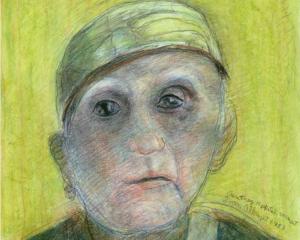
Posthumous works of art and literature support this idea, I believe. One of the most astounding things I've seen at the Art Institute was a series (a progression) of Ivan Albright's self portraits, two of which are below. The last portrait he did before his death (1983) is shocking. Though it may sound obvious, his head takes up less and less space in each composition. The portraits seem fuller of questions at the end, not finality or decisiveness that would point towards an artist at their peak. This is not to assert that artists make their best work at some other time and then slowly fall downhill until death; rather, it is to say, that death is a progression that is unavoidable, but it is not related to making. I would also argue that it is hard for any maker to live up to the pressure of last works and posthumous work; the symbol that they stand for themselves is enough.
I remember being curious about Gilbert Stuart's unfinished portrait of George Washington in my art history texts--wondering why it was important in terms of art history. I think of it as an amazingingly important work to my own understanding of the phenomenological power of an image and a painting; but I don't think that is often the topic of art history books.
Other posthumous works that I have been interested in are Wei Wu Wei's Posthumous Pieces (which was printed in Hong Kong many years before Wei's death, but is still interesting in this context, as it deals with the death of a sense of individuality or identity in some respects) and Roberto Bolano's 2666. There is a wiki list of works published posthumously, found here:
http://en.wikipedia.org/wiki/List_of_works_published_posthumously
Ivan Albright, Self Portrait 1980 Ivan Albright, Self Portrait, 1983

The fog is a strong presence outside today, and undoubtedly it reminds me of the symbol of Auden's last works. The fog is not only an element of weather that creates a different sense of space and feeling of being outside (moisture hanging heavy in the air) but it is also an element of ambiguity, an obscurer, the thing that erases edges that are a distance away. Its density is at once tangible and soft, and I actually find it quite comforting, even in the winter months.
Is there a visual reminder connected to fog? To a sort of passage that could be connected to what is after life? Not 'the afterlife', mind you, which is a concept wrought with pre-determined images. I might argue that fog creates a spatial complexity that leads to our typically path-oriented minds to be less sure of the direction in which one should travel, in a metaphoric and metaphysic sense. It is not that we don't know where we are going, but the space that we typically understand as being a part of the journey is less clear than normal.
Posthumous works of art and literature support this idea, I believe. One of the most astounding things I've seen at the Art Institute was a series (a progression) of Ivan Albright's self portraits, two of which are below. The last portrait he did before his death (1983) is shocking. Though it may sound obvious, his head takes up less and less space in each composition. The portraits seem fuller of questions at the end, not finality or decisiveness that would point towards an artist at their peak. This is not to assert that artists make their best work at some other time and then slowly fall downhill until death; rather, it is to say, that death is a progression that is unavoidable, but it is not related to making. I would also argue that it is hard for any maker to live up to the pressure of last works and posthumous work; the symbol that they stand for themselves is enough.
I remember being curious about Gilbert Stuart's unfinished portrait of George Washington in my art history texts--wondering why it was important in terms of art history. I think of it as an amazingingly important work to my own understanding of the phenomenological power of an image and a painting; but I don't think that is often the topic of art history books.
Other posthumous works that I have been interested in are Wei Wu Wei's Posthumous Pieces (which was printed in Hong Kong many years before Wei's death, but is still interesting in this context, as it deals with the death of a sense of individuality or identity in some respects) and Roberto Bolano's 2666. There is a wiki list of works published posthumously, found here:
http://en.wikipedia.org/wiki/List_of_works_published_posthumously
Ivan Albright, Self Portrait 1980 Ivan Albright, Self Portrait, 1983
 |
| Gilbert Stuart, 1796 |
 |
| January 28, 2013 Des Moines, Iowa |
Subscribe to:
Posts (Atom)